Thailand Fields Anti-Drone Trigger as U.S. and Russian Carriers Diverge on Overhaul and Retirement
Updated · 2026-11-06 11:37 · 6 sources cited
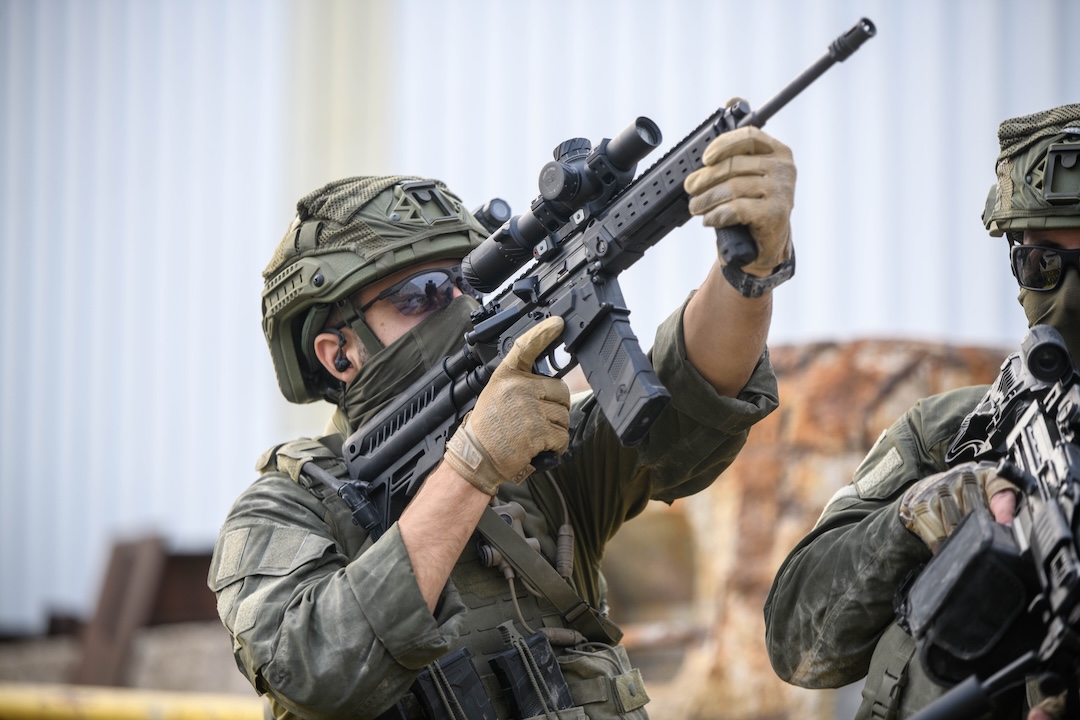
From a rifle trigger in a Thai infantry squad to a carrier dry dock at Newport News and a Northern Fleet pier in Murmansk, military modernization is being reshaped by the same hard constraints: budgets, industrial capacity and low-cost battlefield threats. Some are using algorithms to upgrade existing weapons, some are paying the price of overhaul cycles lasting more than a decade, and once-formidable vessels that symbolized blue-water ambition are quietly leaving the fleet.
An Algorithmic Trigger Reaches Thai Infantry Squads
According to an announcement by Israel Weapon Industries (IWI), Thailand's Ministry of Defence has begun fielding a computerized rifle trigger designed to help soldiers shoot down small drones. The system is the Arbel Anti-Drone System, whose core is a computer installed in the lower receiver of a standard AR-15 rifle, with the computer controlling the trigger mechanism. In an interview with Defense News, Semion Dukhan, IWI's marketing director, said the first round after the shooter pulls the trigger is still fired purely mechanically; from the second round onward, the system controls the burst rhythm at a preset rate of fire determined after analyzing thousands of test shots. [1]
Dukhan described the target profile as about 10 to 15 inches in diameter, flying at about 60 kilometers per hour, and engaged at ranges of 150 to 200 meters. When IWI first unveiled Arbel in 2024, it was positioned as improving soldiers' accuracy under stress; early promotional videos showed a shooter holding the trigger while the system released a round only when conditions were right. The anti-drone version instead uses an algorithm to calculate rate of fire, and Dukhan said its logic 'is only about timing,' making it more predictable than the original stability-based version and allowing the shooter to focus on aiming and tracking the target. [1]
IWI says about 25 countries adopted Arbel before Thailand, either to improve accuracy or for counter-drone use. Dukhan called counter-drone options such as lasers, high-powered electronics, interceptors and specialized ammunition 'not viable in the long run,' citing limits involving cost, mobility or ease of use, and said Arbel's advantage is that it adds a computer to the trigger of an existing rifle, turning any gunner into a counter-drone operator. The appeal of that approach is low-cost modification of existing equipment, but its effective range and per-shot hit probability still depend on the shooter and the ammunition. [1]
Truman Enters the Dry Dock: $5.1 Billion and 2,100 Days
On September 30, 2026, the U.S. Navy awarded Newport News Shipbuilding, part of Huntington Ingalls Industries, a $5.1 billion fixed-ceiling incentive contract for the refueling and complex overhaul (RCOH) of the Nimitz-class nuclear-powered aircraft carrier Harry S. Truman (CVN-75). It is the eighth Nimitz-class carrier to undergo RCOH and the first carrier RCOH contract since the Navy established the Portfolio Acquisition Executive for Maritime (PAE Maritime). [6]
RCOH takes place every 25 years and involves cutting a large hole in the hull and replacing components from catapults to water purifiers. As a schedule reference, the RCOH for George Washington (CVN-73) took 2,100 days; Truman is not expected to return to the fleet before November 2031. The Navy applies a 'one-third rule' to nuclear-powered carriers: at any given time about one-third are deployed, one-third are preparing to deploy and one-third are in maintenance, meaning that with 11 carriers only three or four are typically available for combat missions. [6]
This cycle directly shrinks available forces. The report noted that the crew of the long-forward-deployed Abraham Lincoln (CVN-72) has endured saturated operations and longer periods away from port. For the Navy, RCOH is an unavoidable part of extending the service life of nuclear-powered carriers, but with each ship in the yard for years and each contract valued in billions of dollars, the tension between shipyard capacity and fleet availability will only become more acute as more carriers enter overhaul windows. [6]
The De Facto Exit of Admiral Kuznetsov and Pyotr Velikiy
Russia has effectively retired two of its largest surface warships: the aircraft carrier Admiral Kuznetsov and the nuclear-powered battlecruiser Pyotr Velikiy. Kuznetsov, Russia's only aircraft carrier, has been undergoing an overhaul in Murmansk since 2017; the work has been paused since 2024, and its chances of returning to service are slim. Pyotr Velikiy, meanwhile, will not receive further modernization like its sister ship Admiral Nakhimov, and its ultimate fate remains undetermined. Both ships are still formally listed in the Russian Navy's fleet, but they have in substance been abandoned. [3]
Kuznetsov's predicament has a clear industrial background. After the collapse of the Soviet Union, the important shipbuilding facility at Mykolaiv fell under Ukrainian ownership, Russia's defense budget was sharply cut, the new-build carrier Ulyanovsk was canceled at about 40% completion at the end of the Cold War, and many shipbuilding enterprises went bankrupt or converted production in the 1990s. The Russian Navy kept Kuznetsov, but it lacked the money and industrial capacity needed to sustain a carrier with such a heavy maintenance burden. [3]
In 2018, Russia's largest floating dry dock, PD-50, sank and its crane struck the carrier, punching a large hole in the flight deck; in 2019, a fire aboard the ship killed 2 people and injured more than a dozen. The report concluded that the loss of PD-50 and the fire very likely ended the ship's chances of returning to the fleet, while the war in Ukraine further squeezed an already tight defense budget. [3]
Pyotr Velikiy's outcome contrasts with the modernization of Nakhimov. After more than 20 years of modernization, Nakhimov is completing sea trials and is expected to rejoin the Russian Navy by the end of this year, equipped with 80 missile cells for Oniks, Kalibr and Zircon missiles, plus 96 tubes for a navalized S-400, at a cost estimated at $2.3 billion to $5 billion. [4]
Pyotr Velikiy was originally supposed to receive the same modernization afterward, but at the end of October Russian media reported that, because of budget constraints, the Navy had decided not to modernize it. Vladimir Maltsev, head of the All-Russian Fleet Support Movement, said a dedicated commission had made a preliminary decision and that the final decision had not been announced; 'this cruiser cannot be restored,' he said, partly because of hull wear. He also said the Kirov class was one of the most successful shipbuilding projects in Soviet history, and that Nakhimov is now the only nuclear-powered cruiser left. [4]
MBT-70: A NATO Tank Partnership That Never Came Together
In 1963, 18 years after U.S. and German armies fought each other in Europe, the two countries agreed to design a main battle tank for NATO, the MBT-70, with a development budget of $80 million. NATO equipment standardization was poor at the time: member countries had different tanks, artillery, aircraft and rifle ammunition, while the Soviet Union and Warsaw Pact countries across the border shared tanks, guns, aircraft and ammunition. The appearance of the Soviet T-62 tank made the United States realize that both the M-48 Patton and the then-newer M60 could be outmatched. U.S. Defense Secretary Robert McNamara believed that sharing development costs and joint production would let the two countries build an advanced tank other NATO countries could afford. [5]
Disagreements emerged almost immediately. The United States wanted a tank that could deploy globally and had nuclear, biological and chemical protection, requiring expensive air filtration and air conditioning, and it advocated the Shillelagh anti-tank missile instead of a high-velocity gun; Germany insisted on a conventional high-velocity gun and wanted a tank better suited to Europe's climate and terrain, and not so heavy that it would damage roads. The two sides also clashed over imperial versus metric units, so parts that could have been common were not interchangeable. The driver was placed in a cupola inside the rotating turret and emerged dizzy and nauseated. [5]
By 1968, the project bill had passed $303 million and the unit price had reached $1 million. Germany withdrew in 1969 and the United States in 1971, and the two countries went on to develop the Leopard 2 and the M1 Abrams. MBT-70 did not become NATO's standard tank, but it left technical and management lessons for later vehicles; the episode shows that the durability of multinational cooperation depends not only on the size of the budget but also on whether operational requirements, industrial standards and project management can be aligned. [5]
Fort Hood Victims and the Gap in Memorial Rolls
On November 5, 2009, Army Maj. Nidal Hasan opened fire at the Soldier Readiness Processing Center at Fort Hood, Texas, killing 12 soldiers and a civilian physician assistant and wounding 32 people. Seventeen years later, those dead and wounded still appear on few memorials or databases marking post-9/11 casualties, even though they were awarded the Purple Heart more than a decade ago. The Fort Hood November 5 Memorial in Killeen honors the dead and wounded with pillars, etched photographs and sculptures; the Middle East Conflicts Wall Memorial in Marseilles, Illinois, also bears the names of the Fort Hood fallen, alongside those killed in the 2015 attack on a recruiting center in Chattanooga, Tennessee, and active-duty personnel who died on September 11, 2001. [2]
Carla McPhee, vice president of the Middle East Conflicts Wall Memorial, said the sponsors had wanted from the start to include service members killed in terrorist attacks regardless of where they occurred, because 'the enemy and the sacrifice are the same.' But the Army's own Global War on Terrorism Memorial and its online database, as well as the Defense Casualty Analysis System, which categorizes casualties by conflict, do not include the Fort Hood fallen; neither do non-military databases maintained for more than 20 years by organizations including Military Times and CNN. Retired Army Col. Kathy Platoni, who treated the wounded at Fort Hood, called the omission unacceptable: Congress specifically authorized the Purple Heart through the National Defense Authorization Act, but the classification of the event never changed and it is still regarded as workplace violence. [2]
A Common Thread
These threads point to the same question: how militaries sustain credible capabilities with limited resources. Thailand chose to modify existing rifles with a computerized trigger, a low-cost 'software upgrade' against small drones; the U.S. Navy is paying $5.1 billion for a nuclear carrier's refueling overhaul and accepting a schedule measured in years, showing that the maintenance cost of high-end platforms is itself part of combat power; Russia's abandonment of Kuznetsov and Pyotr Velikiy shows that when industrial capacity and budgets tighten at the same time, the symbolic value of large surface ships is hard to convert into sustained presence. The failure of MBT-70 and the gap in Fort Hood memorial rolls seem unrelated, but both involve classification and standards: the former split because requirements and standards could not be unified, while the latter keeps the dead off memorial rolls because of how the event was characterized. What to watch next: whether add-on counter-drone solutions such as Arbel can scale across more militaries, how the U.S. Navy schedules RCOH for subsequent carriers, and how Russia sustains its nuclear-powered cruiser force after Nakhimov returns.
Sources
- [1] Israeli defense company says this trigger is programmed to shoot drones · 2026-11-05 22:00 · www.defensenews.com
- [2] Fort Hood shooting victims not memorialized among Global War on Terror casualtie · 2026-11-05 21:00 · www.militarytimes.com
- [3] Russia’s 58,000-ton Admiral Kuznetsov ‘Mazut’ Aircraft Carrier Will Never Sail A · 2026-11-05 21:52 · www.19fortyfive.com
- [4] Russia’s Nuclear Kirov-Class Battlecrusier Pyotr Velikiy Is a Powerhouse on Pape · 2026-11-05 20:55 · www.19fortyfive.com
- [5] The US Military and Germany Spent $303 Million on a Tank That Made Its Driver Si · 2026-11-05 22:34 · www.19fortyfive.com
- [6] The US Navy’s 100,000-ton Nimitz-class Nuclear Aircraft Carrier USS Harry S. Tru · 2026-11-05 22:01 · www.19fortyfive.com