US Navy Sticks With Nuclear Submarines; AUSA 2026 Innovation and Ammunition Supply Chain Under Pressure
Updated · 2026-11-05 11:37 · 6 sources cited
The US defense establishment is adjusting along two tracks: it continues to rely on nuclear-powered submarines for rapid open-ocean deployment and is promoting unmanned systems and soldier equipment innovation at AUSA 2026; at the same time, pressure to replenish ammunition stockpiles is drawing attention to environmental and safety liabilities at aging ammunition plants. The choice between nuclear submarines and the AIP route, European naval drone cooperation, and the community costs of the ammunition supply chain together form a window into these defense developments.
The Nuclear Submarine Path: Trade-offs in Speed, Space, and Logistics
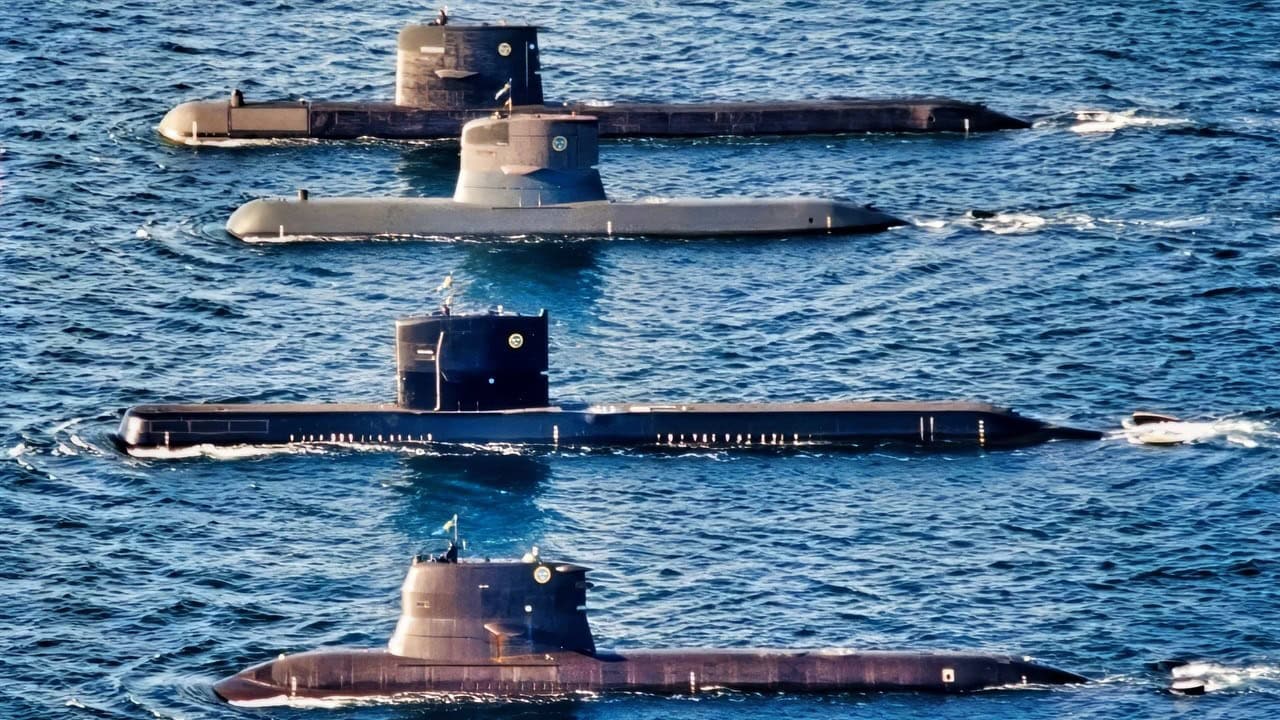
The US Navy currently operates 68 to 71 nuclear-powered submarines, out of about 150 nuclear submarines worldwide; the rest are distributed among Russia, China, India, France, and the United Kingdom. At the same time, more than 40 navies operate 320 to 330 diesel and air-independent propulsion (AIP) submarines.[1] Behind that numerical contrast lies a choice of path: a US nuclear submarine can reach the South China Sea from San Diego in just 12 to 15 days, whereas diesel or AIP submarines seeking to remain quiet often crawl at under 6 knots, while target ships cruise at 18 to 25 knots over the same period.[1] Nuclear power's speed and endurance free the boat from frequent surfacing or reliance on vulnerable tankers; diesel and AIP submarines must give up limited hull space to fuel and liquid oxygen and limit electricity for sensors.[1] The United States chose the nuclear path in 1954 with USS Nautilus, and that choice still rests on open-ocean deployment and logistics independence.[1] AIP systems also have their advantages: fuel-cell AIP uses pure hydrogen and liquid oxygen in an electrochemical reaction and is almost completely silent; closed-cycle internal combustion engines, MESMA steam turbines, and conventional diesel-electric systems each have their own fuel and mechanical configurations.[1] These technical differences determine the trade-offs different navies make among quietness, speed, and sustained deployment.
AUSA 2026: From Wearable Drone Detection to Soldier Systems
As the US military seeks new capabilities and advanced systems, defense companies of all sizes showcased solutions at AUSA 2026.[2] Exhibits ranged from vehicles to wearable drone detection devices, with new soldier systems among the focal points.[2] At the same time, the Smithsonian's Air and Space Museum debuted a new exhibition on Veterans Day focused on aircraft and weapons from post-WWII conflicts; international weapons makers rolled out new interceptors and armored vehicle deals, and a US company secured a fighter contract.[2] These moves show that defense innovation is no longer driven only by traditional giants; the rapidly changing character of conflict is pushing companies to iterate faster.[2]
International Arms Deals and the Defense Innovation Ecosystem
From industry stalwarts to small startups, defense tech creators are looking for solutions as the character of conflict changes almost monthly; AUSA 2026 became a window for showcasing those solutions.[3] International weapons makers advanced new interceptor and armored vehicle deals over the same period, while a US company won a fighter contract.[3] This multi-layered competition shows that the defense innovation ecosystem is expanding: large firms provide mature platforms, startups add rapid iteration capacity, and international deals push new concepts into the market.[3]
Saildrone Partners With Norwegian Shipyard to Expand in Europe's Naval Drone Market
US naval drone maker Saildrone has chosen Norwegian naval builder Umoe Mandal to produce the Surveyor multipurpose surveillance craft locally in Norway, aiming to expand sales in Northern Europe.[4] Umoe Mandal, headquartered at Norway's southern tip reaching into the North Sea, specializes in composite structures for the naval sector, including masts for the British Type 26 frigates. CEO Tom Fidjeland said at the Euronaval trade show that taking on Surveyor production was 'technically not difficult,' with a first mold already being prepared.[4] Under the plan, Saildrone will provide its autonomy suite, navigation, electronics, and surveillance technology for installation on Norwegian-built hulls.[4] The Surveyor is 20 meters long, powered by a diesel engine and wind, with a 13-meter-high sail-like structure that also houses onboard electronics; it can cruise the ocean alone for up to 100 days, and multiple drones can be networked to expand coverage.[4] Saildrone's lineup also includes the smaller Explorer and Voyager, as well as the still-in-development Spectre, which can carry weapons.[4] European navies' demand for territorial waters monitoring, especially in the Baltic Sea, North Sea, and Arctic, offers market space for such unmanned craft; the procurement track of the Nordic defense cooperation NORDEFCO could generate national task orders.[4] Umoe Mandal plans a new production site near its main plant, with an initial production rate of at least two vessels per month; Saildrone previously announced in October a one-year maritime surveillance mission for the Swedish Navy involving four Voyagers, and Denmark has used the craft since 2025.[4] Saildrone also announced in August that it would establish a European headquarters in Copenhagen and plans to manufacture Spectre hulls in the Netherlands and Surveyor wings in Poland.[4] These localization arrangements are close to customers and help strengthen Europe's maritime defense industrial base.[4]
Environmental Debts at Ammunition Plants: Flooded Chemicals and Persistent Violations
In the fall of 2024, Hurricane Helene hit the US East Coast, and the New River flood peaked at 31 feet in Radford, Virginia. Just downstream, the Radford Army Ammunition Plant had warehouse doors torn open by floodwaters, and more than a dozen storage containers were washed away, containing thousands of gallons of toxic chemicals.[5] The Army did not warn residents until weeks later that the containers held dibutyl phthalate—a key component of rocket propellant linked to cancer and reproductive problems—along with hundreds of gallons of diesel and more than 100,000 pounds of wastewater contaminated with calcium sulfate.[5] Officials later said they assumed the containers would sink to the riverbed and floodwaters would dilute any leakage; but at least one container washed up on nearby land and was partially drained, and two years later three remained unaccounted for, with the Virginia Department of Environmental Quality finding that more than 1,500 gallons had leaked into the environment.[5] This was not an isolated incident: Radford had already been penalized earlier in 2024 for excessive pollutant discharges into the New River, faced similar penalties in 2023, and in 2022 was listed by Virginia environmental regulators as the state's largest emitter of toxins.[5] Alyssa Carpenter, founder of the advocacy group Citizens for Arsenal Accountability, said the plant was repeatedly penalized for lead emissions, toxic air emissions, or burning chemicals beyond limits.[5] Radford is also the sole domestic producer of certain artillery and rocket propellants, and the Pentagon is partly relying on this network of aging Army ammunition plants as it replenishes stockpiles and increases production.[5] As production pressure rises, environmental and safety debts become easier to place behind production missions.[5]
Replenishing Ammunition Stockpiles and the Community Cost
Under pressure to replenish ammunition stockpiles, the environmental record of aging ammunition plants is raising more concern.[6] Mathy Stanislaus, who has worked on EPA toxic substance cleanup, said the record of Defense Department agencies is not good: 'It's always defense. That's our mission. Everything else is secondary.'[6] Advocates worry that demanding more ammunition production could further increase risks to local communities, with workers and nearby residents often bearing the consequences.[6] For the Pentagon, ammunition production capacity and supply chain resilience are hard requirements; for communities around plants such as Radford, chemical containers washed away by floods and a persistent record of violations are the other side of the same mission chain.[6]
Common Threads and What to Watch
These threads point to the same backdrop: the US defense system is accelerating unmanned systems, soldier equipment, and international cooperation while maintaining its high-end undersea advantage; but expanding the ammunition supply chain is not cost-free, and environmental and safety debts at aging facilities may become more prominent as production pressure rises. Going forward, watch the size and deployment tempo of the US nuclear submarine fleet, whether systems shown at AUSA 2026 enter procurement, the progress of Saildrone's localized production in Europe, and how ammunition plants such as Radford balance higher production with environmental remediation.[1][4][5]
Sources
- [1] Why the US Navy Won’t Build Diesel or Stealth AIP Submarines Summed Up in 1 Word · 2026-11-04 21:36 · www.19fortyfive.com
- [2] Rise of the defense industry innovators | Defense News Weekly Full Episode 11.3. · 2026-11-05 02:27 · www.militarytimes.com
- [3] Rise of the defense industry innovators | Defense News Weekly Full Episode 11.3. · 2026-11-05 02:27 · www.defensenews.com
- [4] Saildrone expands its European market reach with manufacturing partner in Norway · 2026-11-04 20:37 · www.defensenews.com
- [5] The Pentagon needs more ammo for the Iran war. Small communities are paying the · 2026-11-05 01:38 · www.militarytimes.com
- [6] The Pentagon needs more ammo for the Iran war. Small communities are paying the · 2026-11-05 01:38 · www.defensenews.com