U.S. Death Toll in Iran War Reaches 23 as Air Force Turns to 3D Printing and Congress Escalates Oversight Push
Updated · 2026-11-05 11:34 · 6 sources cited
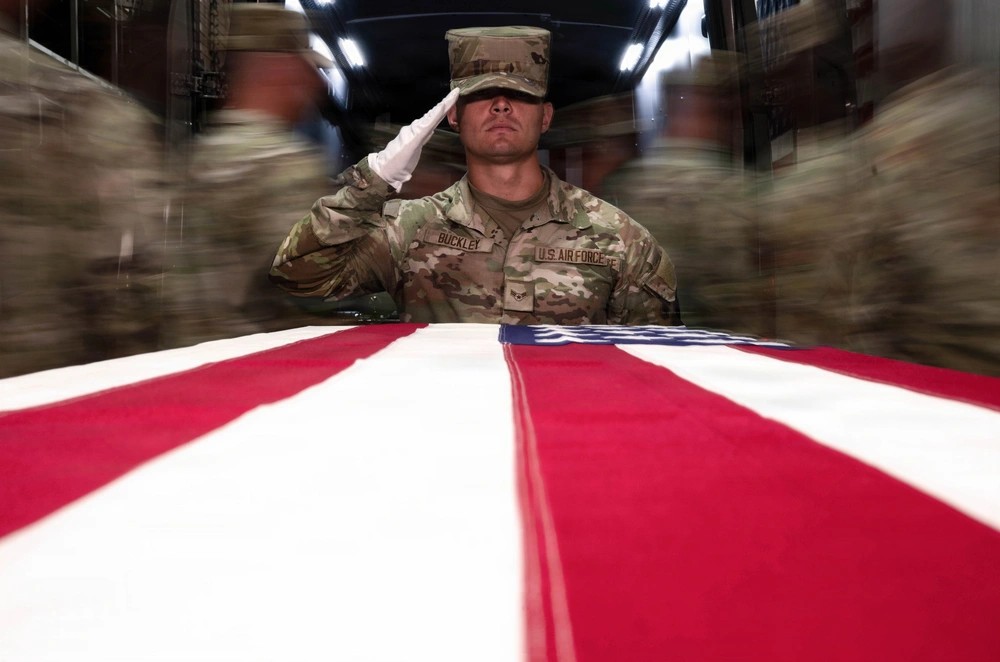
With the war in Iran grinding on and casualties and costs mounting, the U.S. military is confronting two fronts at once: the battlefield toll and the gaps in base protection it has exposed, and political pressure from Congress to restore oversight and reset budget priorities. A training death in Japan is a reminder that risk outside the main theater has not gone away.
Toll rises to 23 as 'non-hostile' designations draw scrutiny
The Air Force confirmed to Military Times that two unidentified airmen died last week in 'non-hostile' incidents, raising the number of American fatalities since the war in Iran began to 23. One was an active-duty service member and the other was in the Air National Guard; both were mid- to senior-enlisted personnel in E5 to E9 grades, one between 31 and 35 years old and the other over 35.[1][3]
The Pentagon's Defense Casualty Analysis System lists both under the 'non-hostile' category, meaning their deaths are not related to direct combat operations: one death was illness- or injury-related, while the other is listed as 'pending' and is under investigation. One airman died in U.S. Central Command's area of responsibility, which spans from Northeast Africa across the Middle East to Central and South Asia; the other died in the United States. The Air Force has not released their names, and a spokesperson declined to explain why.[1][3]
The dispute over how the deaths are counted centers on how the operation is classified. Both are listed under the 'Overseas Operations' category rather than 'Epic Fury'; Pentagon officials say that is because the United States has determined that Epic Fury has ended. The Overseas Operations category begins on July 7, connecting to the continuing campaign of pressure on Iran; a defense official had previously cited May 5 to Military Times. Overseas Operations now lists eight service members, four killed in hostile action and four non-hostile, while Epic Fury lists 15. Together, 23 service members have been killed and 866 wounded since the war began on Feb. 28.[1][3]
The classification has drawn criticism from Democratic lawmakers, who accuse Defense Secretary Pete Hegseth of trying to obscure the casualties. For the U.S. military, the accounting rules affect not only survivor benefits and public disclosure but also Congress's ability to assess the cost of the war; when an operation is moved out of a named campaign, outside tracking of the toll depends more heavily on what the department chooses to disclose.[1][3]
After Middle East bases damaged, Air Force bets on mobile 3D concrete printing
With many U.S. bases in the Middle East damaged by Iranian bombardment, the Air Force wants to develop mobile 3D concrete printers so protective buildings can be erected quickly. The service's Small Business Innovation Research solicitation put it bluntly: the Air Force has spent decades building exquisite kill chains while too often housing the airmen who sustain them in tents, trailers, and flat-walled structures that were never designed for the threat environment now arriving overhead.[2][5]
The solicitation is a direct-to-Phase II project and closes in January 2027. The Air Force's goal is to let military engineers rapidly print protective structures using automated or semi-automated construction workflows, reduced skilled labor and locally available cementitious materials. In 2023 the service already used 3D printing to rebuild hurricane-damaged Tyndall Air Force Base in Florida, and a Maryland Air National Guard civil engineer squadron is developing its own mobile concrete printer.[2][5]
The push is driven by real losses. According to a September 2026 report from the Defense Department inspector general, hundreds of U.S. military buildings across eight Middle Eastern countries were damaged in Iranian attacks. The Air Force argues that existing 3D concrete printing technology has yet to solve the core combination needed for combat survivability: printable expeditionary materials, operational processes that can be executed in the field, and structural geometries optimized against blast waves and fragmentation.[2][5]
The project will assess the strength, adhesion and local availability of cement-like materials, and develop geometries that outperform conventional flat-walled structures by reducing blast reflection, limiting pressure amplification, disrupting fragmentation paths and improving protection for occupants inside. The end goal is for lightly trained military personnel to erect structures quickly and consistently under austere conditions. The Air Force also sees dual-use promise for critical infrastructure and humanitarian response, though the solicitation notes that commercialization still requires approvals including building codes.[2][5]
The oversight fight: from the Iran war to interceptor stockpiles
Rep. Adam Smith, D-Wash., is making Pentagon oversight a central priority in his bid to reclaim the chairmanship of the House Armed Services Committee. In a Wednesday letter to Democratic colleagues, he called for more public testimony from senior defense officials and the restoration of a dedicated oversight subcommittee, listing strikes in the Caribbean and the war with Iran — which he called 'illegal' — among his top concerns. He also questioned the need for a defense budget exceeding $1 trillion, arguing that Congress must reassert its authority over military policy in the face of what he described as a 'runaway Executive Branch.'[4]
Smith is currently the committee's ranking member; it is chaired by Alabama Republican Rep. Mike Rogers. After this week's midterm elections put Democrats in control of the House and Senate, new committee chairs will be elected for the next legislative session. Smith chaired the committee from 2019 to 2023.[4]
On budget structure, Smith argues for more investment in low-cost munitions, uncrewed systems, and drone and missile defense. A Congressional Budget Office analysis shows the war with Iran has consumed as much as two-thirds of the U.S. interceptor stockpile, and replenishing it could take at least five years; the military is using interceptors that can cost millions of dollars each against far cheaper adversary drones. Smith also criticized the president's proposed battleship fleet, arguing that what is needed is a sensible mix of high-end survivable systems and low-cost attritable capabilities, not a 'nuclear-powered battleship fleet.'[4]
He is also demanding closer scrutiny of Pentagon contract awards and funding support for private companies, to determine whether those arrangements serve taxpayers or are shaped by favoritism. Smith acknowledged congressional efforts to streamline the Pentagon's acquisition process but said lawmakers still need to know how defense money is being spent.[4]
Marine killed in training incident in Japan
The Marine Corps announced that a Marine assigned to the 3rd Marine Division died Tuesday 'following a training incident' at Camp Schwab on Okinawa, Japan. The Corps said the incident is still under investigation, that the Marine's name would be released 24 hours after next of kin were notified, and provided no further details. A spokesperson offered deepest condolences to the Marine's family and friends.[6]
Camp Schwab sits on Japan's east coast facing the Pacific. The death occurred outside the main combat theaters, but coming on top of the casualties from the Middle East war, it has sharpened attention on personnel safety across the force.[6]
Analysis: the cost of war is spreading from the battlefield to institutions
The impact of the war in Iran is no longer confined to combat itself: how casualties are counted shapes how the public understands the price of the war, base protection needs are pushing the Air Force toward rapidly deployable construction technology, and interceptor depletion and budget priorities have become levers for congressional oversight. Three threads are worth watching: how the 'Overseas Operations' and 'Epic Fury' categories affect casualty determinations and congressional questioning; whether the mobile 3D concrete printing project moves from solicitation to fielded units; and whether the next House Armed Services Committee leadership restores the oversight subcommittee and pushes for hearings. The investigation into the training death in Japan will also test how the U.S. military manages personnel risk outside war zones.
Sources
- [1] Amid Iran conflict, ‘non-hostile’ deaths of 2 US airmen raise overseas toll · 2026-11-05 07:08 · www.defensenews.com
- [2] Under threat of air strikes, US looks to bolster base infrastructure with 3D pri · 2026-11-05 04:16 · www.defensenews.com
- [3] Amid Iran conflict, ‘non-hostile’ deaths of 2 US airmen raise overseas toll · 2026-11-05 07:08 · www.militarytimes.com
- [4] Congressman calls for tougher Pentagon oversight in bid for committee chair · 2026-11-05 05:56 · www.militarytimes.com
- [5] Under threat of air strikes, US looks to bolster base infrastructure with 3D pri · 2026-11-05 04:16 · www.militarytimes.com
- [6] US Marine dies after training in Japan · 2026-11-05 03:49 · www.militarytimes.com