US Army Restarts Panama Jungle Training as F-47 Dual Testing, Stealth Bomber Gap and Execution Fight Converge
Updated · 2026-10-13 10:38 · 6 sources cited
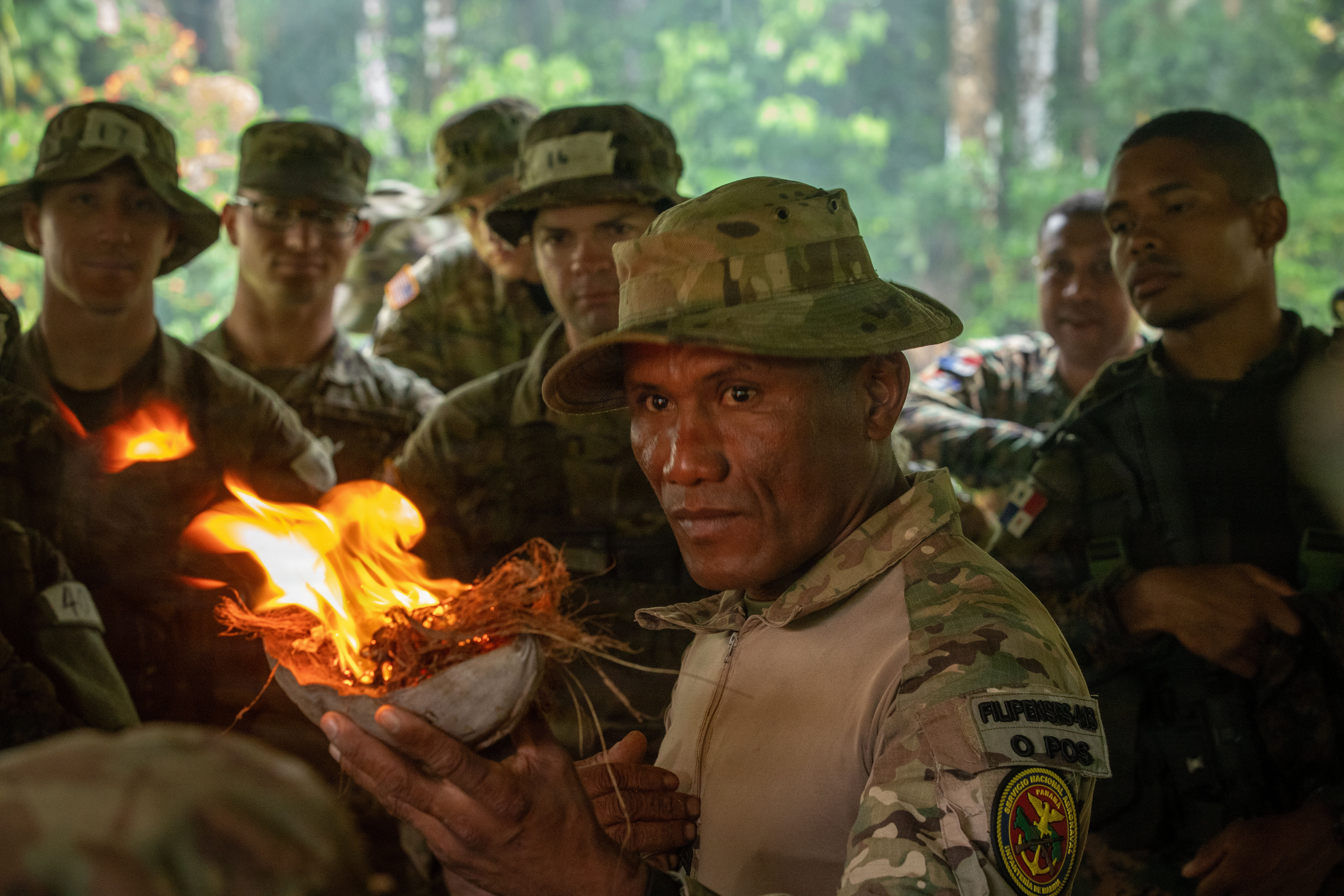
The U.S. Army has restarted its jungle warfare training course in Panama, with Panamanian soldiers serving as instructors and participants; the U.S. Air Force, meanwhile, is pushing parallel developmental and operational testing of the F-47 sixth-generation fighter, with a first flight planned for 2028. At the same time, debate continues over stealth-bomber development experience, a 2009 exercise in which an EA-18G 'shot down' an F-22, and the controversy over U.S. military executions. Together, these threads point to simultaneous adjustments in how the U.S. military accumulates combat experience, tests equipment and manages internal norms.
Panama Jungle Training Restarts as U.S. Troops Learn From Local Forces
The U.S. Army has restarted its Jungle Operations Training Course in Panama. The course had been offered in the Central American nation for decades before it was closed in 1999, and it has now resumed in partnership between U.S. and Panamanian forces. The course lasts 18 days, with Panamanian service members both teaching and attending. [1][4] Lt. Col. Andrew Eagen, who heads the U.S. Army's Jungle Operations Training Center, said that as U.S. forces developed the course, they quickly noticed the survival tactics their Panamanian counterparts had developed. 'They are the experts in this environment, and we will never catch up,' he said. [1][4] He noted that there is no such jungle environment in the continental United States, that U.S. troops lack exposure to it, and that Panamanian soldiers possess skills and adaptability that ordinary Americans can hardly match. [1][4] Currently, nine instructors from the three services of the Panamanian armed forces teach at the rebuilt school, and in addition to the lead instructors, more than 10 Panamanian service members are taking the course. [1][4] Panamanian First Sgt. Albis Fajardo, 47, took part in a counter-drug mission along the Pacific coast years ago when a teammate was shot during an operation targeting a cartel leader. His friend ultimately survived, but the experience pushed him to keep learning and eventually become a jungle warfare instructor. [1][4] During training, Panamanian troops are embedded in U.S. squads, and some classes are supported by Spanish-speaking U.S. personnel. Although the language barrier affects some tactical movements, U.S. troops still learn by observing their Panamanian counterparts' concealment, track-elimination and security positioning. [1][4] This arrangement reflects the U.S. military's renewed emphasis on partner forces' local experience in jungle environments, and it also highlights Panama's role in regional counter-drug and security cooperation.
F-47 Testing Runs on Two Tracks With 2028 First Flight in Mind
The U.S. Air Force is moving deeply ahead with Boeing's F-47 sixth-generation stealth fighter program. The Air Force Test Center at Edwards Air Force Base, California, is conducting both developmental and operational testing of the aircraft at the same time, feeding real data into digital models of fluid dynamics, structural loads and high-angle-of-attack flight to compress the gap between a 2028 first flight and full deployment. [2] The testing strategy does not merge the two phases, but runs them simultaneously, with the core goal of moving developmental and operational testing earlier in the acquisition process. [2] The service hopes to combine traditional flight testing, computer simulation, digital engineering and closer coordination between developmental and operational test organizations into a new acquisition model. [2] The approach was first used on Boeing's F-15EX Eagle II, which reached initial operational capability in 2024 and is seen as a qualified success. [2] In the traditional process, developmental testing evaluates whether an aircraft and its systems meet the technical requirements of a design approved by the Pentagon, while operational testing evaluates whether it can perform missions under realistic combat conditions; the two are usually managed by different organizations. [2] Meanwhile, China's air force is believed to have already flown two sixth-generation fighter models in displays over major cities, while the U.S. side stresses that the F-47 is an 'exquisite platform.' [2] Analysts say the goal of the testing reform is to shorten the period from first flight to combat capability, but the balance between speed and rigor remains a key question.
Stealth Bomber Experience Gap: H-20 vs. B-2 and B-21
On stealth bombers, the development paths of the United States and China stand in contrast. China's H-20 program began in 2016 with the aim of replacing the Xian H-6, but as of 2026 there is still no confirmed test flight or deployment. [5] The United States, by contrast, has built a continuous development chain from Lockheed's F-117 Nighthawk to Northrop Grumman's B-2 Spirit and then to the sixth-generation B-21 Raider, and it has flown the B-2 in combat over Kosovo, Iraq, Afghanistan and Iran. [5] The U.S. Air Force currently operates the F-22 and F-35A single-seat stealth fighters and uses the B-2, the world's only stealth bomber, while preparing to receive the B-21. [5] The report noted that a B-2 named 'The Spirit of Ohio' returned to Whiteman Air Force Base, Missouri, on June 23, 2026, after programmed depot maintenance in Palmdale, California, strengthening the capacity for penetrating long-range strike. [5] Expert Caleb Larson argues that the United States has more than 40 years of low-observable aircraft experience, while China has not fought an air war since Vietnam in 1979, and that the H-20's gap is more about experience than platform design. [5] This view emphasizes that a stealth bomber is not just a single piece of equipment but also involves long-term accumulation in sustained research and development, maintenance, tactics and combat validation.
Revisiting a 2009 Exercise: How an EA-18G 'Downed' an F-22
A 2009 exercise incident continues to draw discussion. During an exercise at Nellis Air Force Base, a U.S. Navy EA-18G Growler electronic-attack aircraft scored a simulated AIM-120 kill on an F-22 Raptor and later wore a 'Raptor kill' marking on its fuselage. [3] The F-22 is widely regarded as the world's premier air superiority fighter, with thrust-vectoring nozzles, supercruise, advanced active electronically scanned array radar, sensor fusion and low observability, optimized for beyond-visual-range 'see first, shoot first, kill first' combat. [3] The EA-18G is the electronic-warfare version of the F/A-18F Super Hornet, a two-seat aircraft equipped with the AN/ALQ-218 receiver system and ALQ-99 jamming pods, and it can also carry AIM-120 AMRAAMs and AIM-9 Sidewinders. [3] Its primary mission is suppression of enemy air defenses and electronic attack, not close-in dogfighting. [3] Some reports suggest the EA-18G pilot used geometry and situational awareness to enter the F-22's blind spots and then lock on with an AIM-120, producing a simulated beyond-visual-range kill; but exercises often impose constraints such as restrictions on radar use, specific rules of engagement and scenario objectives. [3] Electronic warfare can jam radar detection, disrupt sensor pictures and create uncertainty, and when the F-22's advantages in stealth, radar range and speed are limited, the outcome can change. [3] This case is still cited to illustrate the impact of electronic warfare and information warfare on high-end air platforms, while also serving as a reminder that exercise results are not simply equivalent to real combat results.
Death Penalty Dispute: Archbishop Tells Catholic Soldiers to Seek Exemption
The U.S. military plans to execute Fort Hood shooter Nidal Hasan by firing squad, possibly with a livestream, sparking religious and political controversy. U.S. Archbishop Timothy Broglio, who oversees the spiritual care of U.S. military Catholics, publicly asked any Catholic assigned to the firing squad to seek an exemption, saying participation would violate church teaching. [6] Hasan killed 13 people in the 2009 shooting at Fort Hood, Texas; he is now 56 and uses a wheelchair after being shot by police at the time of his arrest. [6] Broglio, who once presided over the funeral of one victim, questioned whether the United States wants to 'imitate the terrorists of the world by turning the brutal killing of an opponent into a public spectacle,' and expressed concern about the effect of a livestream on young viewers. [6] U.S. Army regulations allow service members to request religious exemptions or accommodations, but the Army has not said how it will select firing squad members. [6] U.S. Defense Secretary Pete Hegseth announced the livestream plan last week, drawing opposition from congressional Republicans, religious leaders and international observers; he argues that a public execution could have a deterrent effect and wants soldiers to carry it out at the time, day of the week and place where Hasan committed his attack. [6] U.S. President Donald Trump has approved executing Hasan by firing squad but says he is still deciding whether to allow a livestream. [6] The report noted that government executions have never been broadcast or livestreamed, and that the U.S. military has not executed anyone by firing squad since 1945; Broglio met Pope Leo in Rome on Monday, and the pope condemned the death penalty on Saturday; Vice President JD Vance said he would not watch if the execution is ultimately livestreamed. [6] This controversy puts military justice, religious freedom and the ethics of public communication at the forefront.
Common Trends and What to Watch
From jungle training in Panama to dual-track F-47 testing, the stealth-bomber development gap, the review of an old electronic-warfare exercise and the death-penalty dispute, these threads together show the U.S. military addressing experience accumulation, faster acquisition and internal norms at the same time. Going forward, watch whether the 18-day jungle course becomes permanent and expands U.S.-Panamanian coordination, whether parallel F-47 testing proves effective before the 2028 first flight, how the B-21 and H-20 timelines compare, and whether the decision on livestreaming Hasan's execution changes U.S. military execution procedures and religious-exemption practices. [1][2][3][5][6]
Sources
- [1] The US Army is back in the jungle. Panamanians are showing soldiers the way. · 2026-10-13 06:32 · www.militarytimes.com
- [2] The Air Force’s Boeing F-47 Stealth Fighter Is Not Scheduled to Fly Until 2028. · 2026-10-13 07:19 · www.19fortyfive.com
- [3] US Air Force Stealth Fighter Down: $334,000,000 Lockheed F-22 Raptor Was ‘Shot D · 2026-10-13 07:09 · www.19fortyfive.com
- [4] The US Army is back in the jungle. Panamanians are showing soldiers the way. · 2026-10-13 06:32 · www.defensenews.com
- [5] China’s New ‘Flying Wing’ Xi’an H-20 Stealth Bomber Is Now Frozen In a Developme · 2026-10-13 06:57 · www.19fortyfive.com
- [6] Catholics in US Army must not participate in firing squad, prominent archbishop · 2026-10-13 04:48 · www.militarytimes.com